Chapter One: Function and Personality
Reflection Paragraph:
After reading the first chapter, I kept thinking about carbon fiber as a material and how it emits a certain personality on its own, and transforms the characteristics of things made out of carbon fiber. It is an exotic material that is light weight, and reusable. It's also very strong, but many people aren't aware of these facts. The chapter briefly talks about the wants of a consumer, and how the design as well as the functionality of a product relies on this. However, it is the materials the product is made of which enables both designers and engineers to produce such a thing. I guess that's why I kept thinking of carbon fiber. It is one of those materials that enables designers and engineers to accomplish things that other materials simply couldn't do, or do inefficiently. Carbon fiber as a material can also be used as a an example to convey on of the main messages of the first chapter. That is, we must know the process by which something is created to understand the limits and possibilities of creation. The act of knowing starts from the materials. Once you know the materials, we can get an idea of how it can be manipulated to produce something. It's like a cyclical process. We may want to produce something, but we must know about the materials. We must also know about the process to get an idea of what materials to use. Someone must be an expert in carbon fiber to know what can be made out of it, but they must also be aware of the processes they may potentially use which can alter the end product.
Sunday, October 26, 2014

Field Trip: Zahner

INDD 508 Materials & Processes
Field Trip Notes
Who is/ what is Zahner?
- They are an internationally known fabrication company located in Kansas City who specialize in the use of various types of metals that are eventually applied to art and architecture.
- Designers around the world contract Zahner to supply to them highly crafted architectural metalworks. When touring their facility, I noticed that they liked to experiment with creating various metal surfaces using different tools.
- Zahner works mostly with steel, copper, zinc, and aluminum. However, they some experimental sample works constructed from more exotic metals such as titanium. On Zahner's website, they list a variety of different types of metals, as well as variations of each type of metal, some of which are patented.
- Solanum Steel, Baroque Zinc, Roano Zinc, Angel Hair, GB-60, Hunter Zinc, Star Blue Copper, and Dirty penny are some of their listed products and surfaces they offer.
- Zahner uses different size breakers to bend and shape metal, and punchers to manipulate surfaces of metal.
- Zahner relies on CNC machines to cut their metals with precision as well as create complicated patterns in the metal work.
- Metal sheets are joined in a conventional way such as with glues or hardware if allowed for a project. However, when trying to combine sheets of metal in a way that is unnoticeable, Zahner uses patterned edges to combine pieces together so that joining points are hidden.
- Zahner had many ways of finishing their metal works. They often coat the metals with weather-proof surfaces. They may also manipulate the surface of the metal itself in order to achieve a certain look. For example, making the surface of aluminum coarse to reduce reflectivity, or polishing them to increase it. They also would finish metal surfaces using chemical reactions such as allowing copper to patina to give it an aged appearance.
- I was impressed by how well design and engineering coexisted within Zahner's facility. Some of their metal surfaces were very impressive, and it was interesting to see how often they would experiment with metals. If you go on their website, they have what is called Tessellate which is an animated metal surfaces and it looks like something that you would see in a futuristic movie. Tessellate is an example of how Zahner combines their expertise in design with engineering.
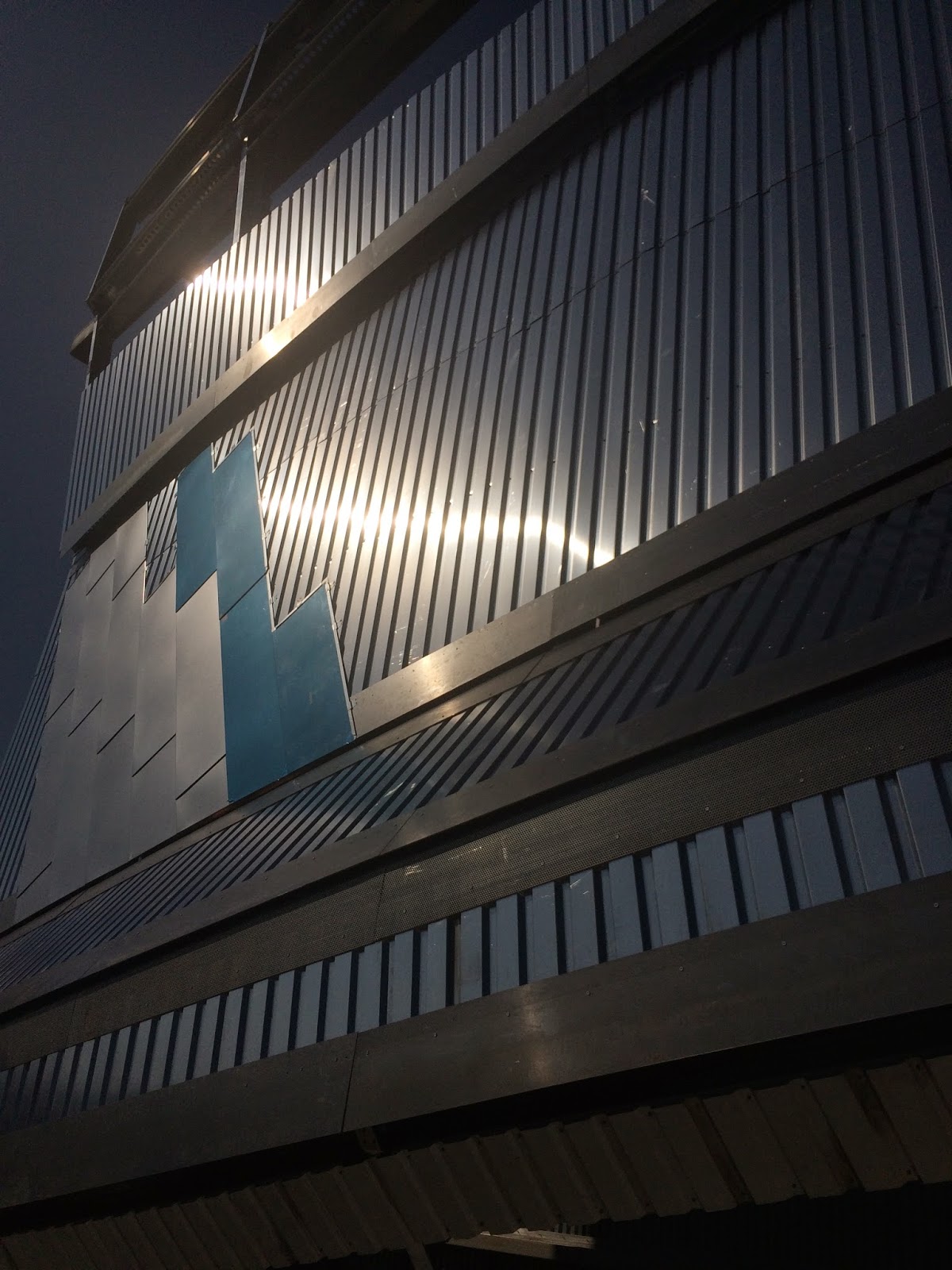
Pictures Taken at Zahner




Thursday, October 2, 2014
Frank Gehry

Guggenheim Museum located in Bilbao, Spain
INDD 508 Materials & Processes
Spencer Visit: Frank Gehry Film
As one of the world's most famous architects, Frank Gehry earns commissions from various parts of the world. Due to his success with the Guggenheim Museum, many locations seek Gehry's expertise in architecture in hopes of bringing economic growth to their cities. The beginning of the film was interesting as well. It sort of foreshadows the seemingly randomness in thought that Gehry seems to portray during the process of building. He doesn't give specific reasons as to why certain shapes exist within a structure. His explanations mostly state that 'it doesn't seem right,' and I think that's part of the cleverness that Gehry possess; he instinctively seems to know what's pleasing to the eye, and what is not.
Matthias Pliessinig

INDD 508 Materials & Processes
Hallmark Speaker
Who is Matthias Pliessinig?
- Matthias Pliessinig is a famous furniture designer who is from Philadelphia.
- Matthias is most famous for his furnitures made of steam bent wood.
- Most of his clients are architects who want to add exotic furniture to their buildings. Matthias also builds furniture for major universities and other public facilities. For example, he was once asked to build custom benches for Harvard's library.
- The most frequently used words and process mentioned by Matthias would have to be steam bending. The majority of his recent works, if not all, are made of wood which require steam bending in order to form into usable furniture.
- For Matthias, steam bending is the most commonly used process to shape wood. Steam bending allows the wood to become pliable by forcing the polymer fibers to become shapable. Steam rollers are also used to heat the resins lying within the wood to force the wood into a pliable state. However, Matthias says that steam rolling is his favorite, and most efficient method of shaping wood. He also mentions kelm drying which is a quick way to dry wood, however, it damages the resins making it harder to manipulate.
- A CNC machine and router are commonly used at Star Signs. The router uses CAD base software to route materials. However, the tools located on sight are somewhat limited in their capabilities to manipulate materials. For example, Star Signs cannot transform aluminum that is thicker than half an inch. In such scenarios, Star Signs simply outsources their work to other companies that can complete their work. Such companies may include Gemini, High Tech Laser, and P1.
- Joints are held by glue and rivets, but pinch clamps are initially used to hold various pieces of wood together.
- Wood furniture is finished by sanding out imperfections, and applying a clear coat to protect the wood through usage and time.
- I thought it was interesting how Matthias had a handful of interns helping him in the process of making pieces of furniture. For as unique as the work is, it's surprising that he allows outside help to finish his projects. I also found it interesting when he mentioned that certain architectural projects that are funded by the public's money are allotted a certain percentage of the budget to fine arts no matter what.

Tuesday, September 16, 2014
Field Trip: Star Signs

http://starsignsllc.com/
Field Trip Notes
Who is/ what is Star Signs?
- They are a sign manufacturer located in Lawrence, Kansas.
- Star Signs makes custom signage and environmental graphics, as well as other various way-finding packages.
- Star Signs uses a wide variety of materials. A common material used is aluminum for their signage since it is relatively easy to manipulate, cheaper than steel, and retains its production ready finish for much longer than steel.
- They use rollers and breakers for materials that require shaping such as aluminum.
- A 8x12' CNC machine and router are commonly used at Star Signs. The router uses CAD base software to route materials. However, the tools located on sight are somewhat limited in their capabilities to manipulate materials. For example, Star Signs cannot transform aluminum that is thicker than half an inch. In such scenarios, Star Signs simply outsources their work to other companies that can complete their work. Such companies may include Gemini, High Tech Laser, and P1.
- Digital printing is used to produce vinyls and aluminum.
- Star Signs has their own Matthews Paint intermixing paint system and spray booth. They also have a machine for color matching. Star Signs also has their custom faux and patina finishes which they did not disclose during the tour.
- I will never really look at signs the same way as I did before. As everyday life is seemingly hectic at times, one does not take the time to look at common things such as signage and wonder who produces them and how they are produced. After taking the field trip to Star Signs, I found myself appreciating signs more than I had before. For example, I had no idea that the green signs that hang by the street lights around Lawrence were actually illuminated by their very own light. When walking to and from campus, I find myself looking at signs more often and think of the ways they are produce, and wonder if they come from Star Signs.
Field Trip: The Reuter Organ Company


INDD 508 Materials & Processes
Field Trip Notes
Who is/ what is the Reuter Organ Company?
- They are a company located in Lawrence, Kansas who produce custom pipe organs. They were originally located in Illinois, but moved to Kansas in 1919.
- They make custom pipe organs for customers around the world. Most customers, however, are churches while the remaining majority of their other customers tend to be colleges and private universities.
- As mentioned above, they produce their custom pipe organs for mainly churches while also doing custom work for universities and colleges. On some occasions, they may get a customer who wants to buy a pipe organ for they own personal uses.
- Larger pipe organs are generally constructed using copper or zinc. They also may use tin on some occasions. Copper and zinc are favored due to the sound qualities they are capable of producing.
- They also have their own in-house lumber mill to make custom lumber for various parts. Out of all the variety of woods they carry in-house, poplar is most commonly used since there are very few knots in the wood.
- Keys on the pipe organ are generally made from plastic, wood, and bone while valves may be made of sheep skin or kangaroo skin.
- Reuter carries complex cutting tools such as a CNC router which is used to drill holes and route out corks in wood. The CNC router also has the ability to cut out complex patterns.
- Materials such as the metals used in the process of producing custom pipe organs at Reuter are joined be welding or soldering. Glues are also used for non-metal materials such as parts made of wood or plastic.
- To keep metals from contamination and to give them a shiny quality, lacquer is used to coat the metal pipes. Pipes are also "aged" for production to further enhance their sound producing characteristics. For copper pipes, Reuter will sometimes allow for oxidation in order to give the pipes a patina. They can also achieve this finish by introducing chemical compounds to the copper such as carbonates, sulfates, sulfides, and oxides.
- I was impressed by the fact that such an intricate instrument such as the pipe organ is mostly hand made. The precision by which they are produced is so impressive, it's hard to believe that a group of craftsman are able to produce these complex instruments with consistency.
Monday, September 8, 2014
Show and Tell: LED watch

For class, I brought in an LED watch for show-and-tell. My LED watch was given to me for my birthday and came from Japan from a company called TokyoFlash. The watch is mostly comprised of stainless steel, rubber, plastics, and LED diodes which let you tell time in a different, unconventional way. The LED diodes are covered in acrylic in order to protect them while the thin metal band is made of stainless steel. Rubber is also used in the wrist portion of the watch to prevent chaffing on the user's arm. Overall, the watch isn't very functional unless you really take the time to learn how to tell time using the watch in a way that is fast and convenient. With that being said, this watch mainly serves as a novelty, allowing users to tell time in their 'own' way.
Honestly, when trying to find the materials and processes by which these specific watches are made, there isn't much information out there.
But here is a cool video on their website that kind of shows what TokyoFlash is all about. In my opinion, these watches are definitely "out there," but it is fitting for the Japanese culture when you look at their current design language and aesthetics in some of their more famous brands like Lexus.
Subscribe to:
Posts (Atom)